
Glasgow rain gives roof moss a head start. On a tenement roof, it settles between Scottish slate courses, holds water against the surface and then sheds into gutters when the next downpour arrives.
That trapped moisture puts pressure on slates and their fixings through winter freeze-thaw cycles. Once moss blocks a valley, parapet gutter or downpipe, rain can spill down sandstone walls and appear as damp in top-floor flats.
The cost is shared. A roof problem can move from a dirty roofline to wet sarking, timber repairs and masonry work that every co-owner must fund.
Historic tenements need roof cleaning that respects their construction. Scottish slate is laid in diminishing courses, with larger slates at the eaves and smaller ones near the ridge. It has endured for generations because water is meant to run freely over it, into clear rainwater goods, and away from the building.
A roof cleaning Glasgow inspection spots the moss, drainage debris and access risks before the roof becomes a common repair dispute. Cleaning early keeps the work focused on growth and gutters, rather than the damage water leaves behind.
Why Moss and Algae Pose a Major Danger to Scottish Slate
Scottish slate can last over 150 years with proper care, according to the Glasgow City Heritage Trust Tenement Guide. Moss and algae shorten that lifespan by keeping the roof wet for longer than the rain itself.
A traditional Glasgow tenement roof uses slate in diminishing courses. Larger slates sit at the eaves, then the courses reduce in size towards the ridge. The overlaps direct water downhill, but growth builds up around those laps and interrupts the route.
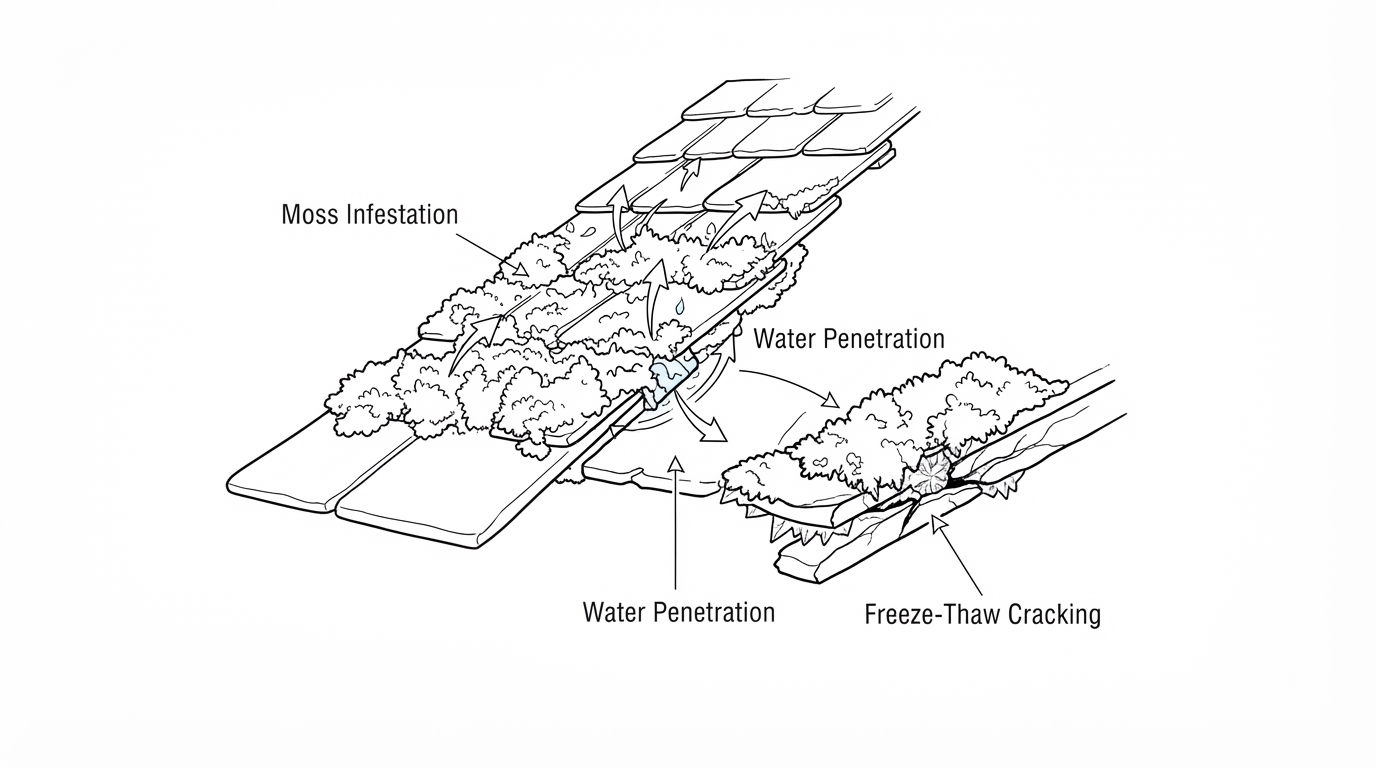
Moss behaves like a wet layer pressed against the roof. In cold weather, retained water freezes and expands, putting force on slate edges and aged fixings. Repeated cycles can prize slates apart, fracture weathered stone and create paths for water below the covering.
The damage does not stop at the slate. Moisture that gets through can wet timber sarking boards and reach loft spaces. Persistent damp also travels through porous lime mortar into sandstone masonry, where it can show up later as internal damp.
A West End roof with thick moss across its slate courses faces this pattern each winter. Water sits beneath the growth, freezes against vulnerable laps, then drains into the roof structure when temperatures rise. The resident may first notice the problem as a damp patch indoors, long after the roofline started holding water.
Roof care needs to keep the slate intact while removing the biological growth. Direct foot traffic on old tiles can crack stone that has already weathered for more than a century, so access and cleaning method matter as much as the moss removal itself.
For a closer look at the local causes of damp, see our guide to tenement sandstone maintenance and damp prevention. The practical priority is straightforward: remove growth gently, keep water moving, and check slate laps before damp reaches the building fabric.
The Devastating Effects of Blocked Gutters and Masonry Saturation
Blocked gutters turn roof moss into a wall problem. Moss washed from a pitched roof collects in narrow valleys, parapet gutters and cast-iron downpipes, where it traps more leaves, grit and water.
Rainwater should leave the roof through clear channels. When a parapet gutter fills, water backs up at the roof edge and spills down the red or blonde sandstone below instead.
That repeated overflow soaks porous masonry. Winter frost can damage wet sandstone, while water moving through mortar and walls can create damp patches in the top-floor flats behind them.
The chain reaction usually follows a familiar route:
- Moss grows across the slate and holds rainwater on the roof.
- Loose clumps wash downhill into valleys and parapet gutters.
- Debris blocks outlets and slows water entering downpipes.
- Backed-up water overtops the gutter and runs over sandstone facades.
- Saturated walls and wet roof spaces lead to repairs shared across the close.
A Victorian sandstone tenement in Glasgow’s Southside can illustrate the consequence. Moss-choked parapet gutters allow water to overflow onto the facade, and damp penetration follows where the wall stays wet instead of drying between showers.
Cleaning a roof properly includes the rainwater goods. Downpipes are plugged before moss is removed, so debris can be collected rather than sent into underground drainage. After the roof surface is cleared, valleys, parapets and downpipes need to be checked for free flow.
This is why a clean-looking roof alone is not enough. Clear drainage keeps rain off the sandstone and out of the building.
Why Aggressive Pressure Washing Destroys Historic Tenement Roofs
High-pressure washing can permanently damage an old slate roof. Water jets above 250 bar can fracture aged slates, strip their protective surface, shear nails and damage lime pointing around roof details.
The force also drives large volumes of water backwards beneath slate overlaps. That water can reach attic insulation and ceilings, creating a damp problem while the roof is being cleaned.

What High-Pressure Washing Does
High-pressure jet washing is a poor fit for historic tenements because the roof was built around overlapping materials and controlled drainage, not abrasive force.
- Shatters brittle or weathered slate laps.
- Blasts away protective slate surfaces.
- Pushes water beneath the roof covering.
- Damages lime pointing around chimneys and details.
- Can void manufacturer warranties.
The Safer Cleaning Approach
Our Outside Clean Roof Care work uses a method chosen for the slate, tile condition and level of biological growth. Heavy moss can be removed with hand scrapers shaped to the tile profile, avoiding abrasive contact with the surrounding surface.
Where rooted lichen or algae needs more treatment, superheated low-pressure steam can heat water to 150 degrees while avoiding mechanical abrasion. The objective is to lift growth without breaking the slate beneath it.
Biocide softwashing follows the physical cleaning. A specialised biocidal wash sanitises the roof surface and destroys microscopic spores at the root, including spores left behind after visible moss has been removed.
The difference matters on a roof with original Scotch slate. A clean roof that has cracked tiles and water under its laps is a worse outcome than a roof with moss. Gentle scraping, low-pressure steam and biocide treatment keep the cleaning work aligned with the roof’s age and material.
Step-by-Step: How Outside Clean Restores Tenement Roofs Safely
A safe tenement roof clean starts with inspection and ends with clear drainage. The work should avoid unnecessary roof walking and keep moss out of the building’s rainwater system.
- Inspect the roof from the ground and air. Aerial satellite views and ground inspection help assess the roof elevation, slate condition, growth levels and practical access route. This identifies fragile areas before any work begins.
- Protect the drainage and ground. Downpipes are plugged to stop dislodged moss entering underground drainage. Paths, nearby windows, masonry and planted areas are protected before debris comes off the roof.
- Set up certified access. MEWPs, scaffold towers or telescopic systems allow work at three and four-storey elevations without walking across vulnerable slate. This is safer for the team and reduces the chance of cracking old tiles.
- Match the cleaning method to the material. Thick moss is removed with gentle manual scraping using blades matched to the slate profile. Deeply rooted biological growth can be treated with low-pressure steam heated to 150 degrees.
- Clear gutters and outlets. High-reach extraction removes debris from valleys, parapet gutters and downpipes. Each route is then checked so rainwater can flow freely from the roof.
- Apply the biocide softwash. The wash covers the cleaned roof surface to deal with spores that remain beyond visible moss. Our treatment includes a written 3-year moss-free guarantee.
- Wash down and remove waste. Ground areas, windows and masonry are rinsed, while collected moss is bagged and removed securely. A final check covers lead valleys, gutters, roof courses and runoff paths.
Consider a Southside tenement where damp has begun in a top-floor flat after moss filled the parapet gutter. Plugging the downpipe before cleaning prevents a second blockage below ground, while high-level access keeps workers off fragile slates. Once the gutter is cleared and the roof receives its biocide wash, the building has a route for rainwater that does not run over the sandstone wall.
The final inspection should confirm three things:
- Lead valleys and gutters have no debris blocking runoff.
- Moss clumps and lichen growth have been removed along the slate courses.
- Ground areas, windows and masonry are clean after the wash-down.
The Economics of Proactive Roof Cleaning vs Tenement Repair Bills
The cheaper bill is the one paid before water damages the structure. Glasgow City Heritage Trust guidance suggests setting aside around 1% of a historic property’s value each year for regular maintenance, which gives owners a basis for planning shared work. That approach is especially relevant to traditional Scottish slate: when properly maintained, these roofs can endure for over 150 years.
Professional roof cleaning ranges from £700 to £6,000, depending on property size, height and access difficulty. For a close with six to eight co-owners, the split is clear:
- £700 split six ways: about £116.67 per owner.
- £700 split eight ways: £87.50 per owner.
- £6,000 split six ways: £1,000 per owner.
- £6,000 split eight ways: £750 per owner.
Those figures cover the widest stated cleaning range. They are easier to plan for than emergency work on rotted sarking, rotted joists or eroded sandstone facades, which can cost tens of thousands across the co-owners. A planned contribution also gives owners time to agree access, arrange the work safely and deal with the full drainage route rather than responding to a leak after damage has spread.
The saving is not simply about removing visible moss. In Glasgow’s wet, low-sun conditions, moss can hold water against slate, while debris in parapet gutters and lead valleys stops rainwater draining freely. The resulting overflow can wet external sandstone and allow damp to move through porous lime mortar. In winter, retained water also increases freeze-thaw stress on ageing slate. A Southside Victorian sandstone tenement, for example, can develop damp penetration where moss-choked parapet gutters are left uncleared; on a West End roof, the same sponge-like moss effect can accelerate spalling across historic slate courses.
Planned work should therefore include an inspection of slate condition and access, careful removal of heavy growth, clearing valleys, parapets and downpipes, and a biocide treatment to address spores left after scraping. For delicate original Scotch slate, high-pressure washing is a false economy: it can fracture brittle stone, shear nails, strip the slate surface and force moisture beneath laps. Gentle contoured scraping, low-pressure biocide treatment, or low-pressure steam for deeply rooted growth protect the material better. A professional biocide softwash treatment may also carry a 3-year moss-free guarantee.
A clean roof also helps the whole building look cared for. That matters when every flat shares the roofline, gutters and exterior walls, and when kerb appeal and property values depend on the condition of the building as a whole.
The practical decision is to treat moss removal, gutter clearing and biocide treatment as planned common maintenance. Waiting for blocked drainage or an internal damp patch changes the job from roof care into a structural repair problem, with a larger bill and more disruption for residents.
Frequently Asked Questions About Glasgow Tenement Roof Cleaning
Can Pressure Washing Damage Historic Tenement Roof Slates?
Yes. High-pressure water can fracture aged Scottish slate, shear fixings, damage lime pointing and force water beneath tile overlaps. Historic roofs should be cleaned with gentle manual scraping, low-pressure steam where suitable, and biocide treatment.
How Much Does Roof Cleaning Cost for a Glasgow Tenement?
Professional roof cleaning in Glasgow starts at £700 and can reach £6,000 for larger tenements with difficult height or access conditions. The final cost reflects the size of the roof, its elevation and access needs.
How Long Does a Biocide Roof Treatment Keep Moss Away?
A professional biocide softwash treatment from Outside Clean has a written 3-year moss-free guarantee. The wash treats microscopic spores left on the roof after visible growth has been removed.
How Do Technicians Access Tall Four-Storey Tenements Without Damaging Tiles?
MEWPs, scaffold towers and telescopic systems provide access without routine walking on fragile slate pitches. The access method is chosen after an inspection of the roof elevation, condition and available space around the building.
Why Are Gutters Cleared During Roof Cleaning?
Moss removed from the roof can block valleys, parapet gutters and downpipes if it is left behind. Clearing those areas restores rainwater flow and helps stop overflow running down sandstone walls.
Protecting Glasgow’s Tenement Heritage with Outside Clean
Glasgow tenement roofs need regular, gentle care. Removing moss, clearing drainage and treating spores protects Scottish slate, limits moisture against sandstone and helps co-owners avoid repair bills that grow after water gets into the building.
Start with a roof inspection that checks slate condition, moss growth, gutters and safe access. Outside Clean uses manual scraping, low-pressure steam and biocide treatments, backed by a written 3-year moss-free guarantee.