
Table of Contents
- Navigating Glasgow City Council Regulations and Conservation Consents
- Why High-Pressure Jet Washing Destroys Historic Scottish Slate
- Approved Cleaning Techniques: Manual Scraping Versus Low-Pressure Steam Cleaning
- Biocide Softwashing: The Vital Second Step for Long-Lasting Protection
- Roofing Characteristics Across Glasgow’s Prominent Conservation Neighborhoods
- Pricing and Maintenance Costs for Slate Roof Cleaning in Glasgow
- Frequently Asked Questions About Slate Roof Cleaning in Glasgow
- Protecting Your Heritage Property with Glasgow’s Slate Cleaning Experts
Glasgow’s rain keeps a slate roof damp long after a shower has passed. In the West End, Pollokshields and the Park District, shade and west-coast humidity give moss, lichen and algae the conditions to spread across old roof slopes.
That growth holds water against the slate. Winter freeze-thaw cycles can then turn a moss cushion into a wet wedge around slates, fixings and timber sarking, while blocked gutters send water where it should not go.
The cost of getting this wrong is larger than an untidy roofline. Scottish slate has not been commercially quarried since the 1950s, so every original slate lost to careless cleaning is a finite piece of the building’s fabric. A heritage roof cleaning service should treat the roof as part of the conservation area, not as an ordinary exterior surface.
High-pressure washing creates the damage homeowners are trying to avoid. It can strip slate layers, force water beneath overlaps and crack thin edges that have already endured decades of weather.
A safe clean starts with an inspection of the slates, leadwork, gutters and access route. It then uses hand scraping or low-pressure steam, followed by a biocide treatment that deals with the growth left inside slate pores.
That approach keeps the original roof covering in place and gives a conservation property the careful maintenance it needs.
Navigating Glasgow City Council Regulations and Conservation Consents
Glasgow City Council’s conservation area designations cover areas where the roofline contributes to the character of the street. The council’s Conservation Area Designations page is the sensible first check before arranging work on an older property.
Listed buildings need particularly close attention to original materials. Unlisted buildings within a conservation area also need work that respects the existing slate, ridge details, flashing and surrounding streetscape.
Glasgow City Council’s DG/DES 3 design guidance restricts harsh cleaning that changes the density or appearance of historic surfaces. Article 4 Directions can also restrict alterations that detract from a conservation area’s character.
Routine care based on non-abrasive methods has a clear purpose: remove biological growth while leaving the original roof material and detailing intact. The work should begin with a visual condition survey, including cracked slates, delamination, nail sickness, lead flashing and timber sarking.

Use these checks before a clean is booked:
- Confirm whether the building is listed, and its category where relevant.
- Check whether an Article 4 Direction applies to the property’s conservation area.
- Keep original slates in place where their condition allows.
- Use access equipment that avoids foot traffic across aged slate.
- Ask for a method that excludes abrasive cleaning and high-pressure water.
If a roof has brittle slates, failed fixings or extensive loss, cleaning should pause for a roof-condition decision rather than cover up a repair issue. A practical guide to Glasgow exterior property maintenance regulations can help you connect damp conditions with the care your roof needs.
The planning point is straightforward. Keep the work focused on careful maintenance, retain historic material and check the property’s status before any method that could alter the roof is chosen.
Why High-Pressure Jet Washing Destroys Historic Scottish Slate
High-pressure jet washing damages historic Scottish slate and should be kept off conservation roofs. The Historic Scotland roof guidance supports careful repair and retention of traditional roof fabric.
Properly maintained Scottish slate can remain in service for 150 years or more. That lifespan relies on the slate layers, overlaps, fixings and sarking staying dry and undisturbed.
A pressure jet attacks several weak points at once:
- It strips and separates thin slate layers, leaving edges more prone to breakage.
- It can shatter aged slate corners and dislodge slates around vulnerable fixings.
- It drives water upward beneath overlapping slates onto timber sarking boards.
- It can loosen mortar pointing at ridges and roof details.
- It can leave moisture where it later contributes to rot and internal ceiling leaks.
Nail sickness makes that risk worse. A slate held by a weakened nail may appear sound from the ground, then move or crack under water force or foot traffic.
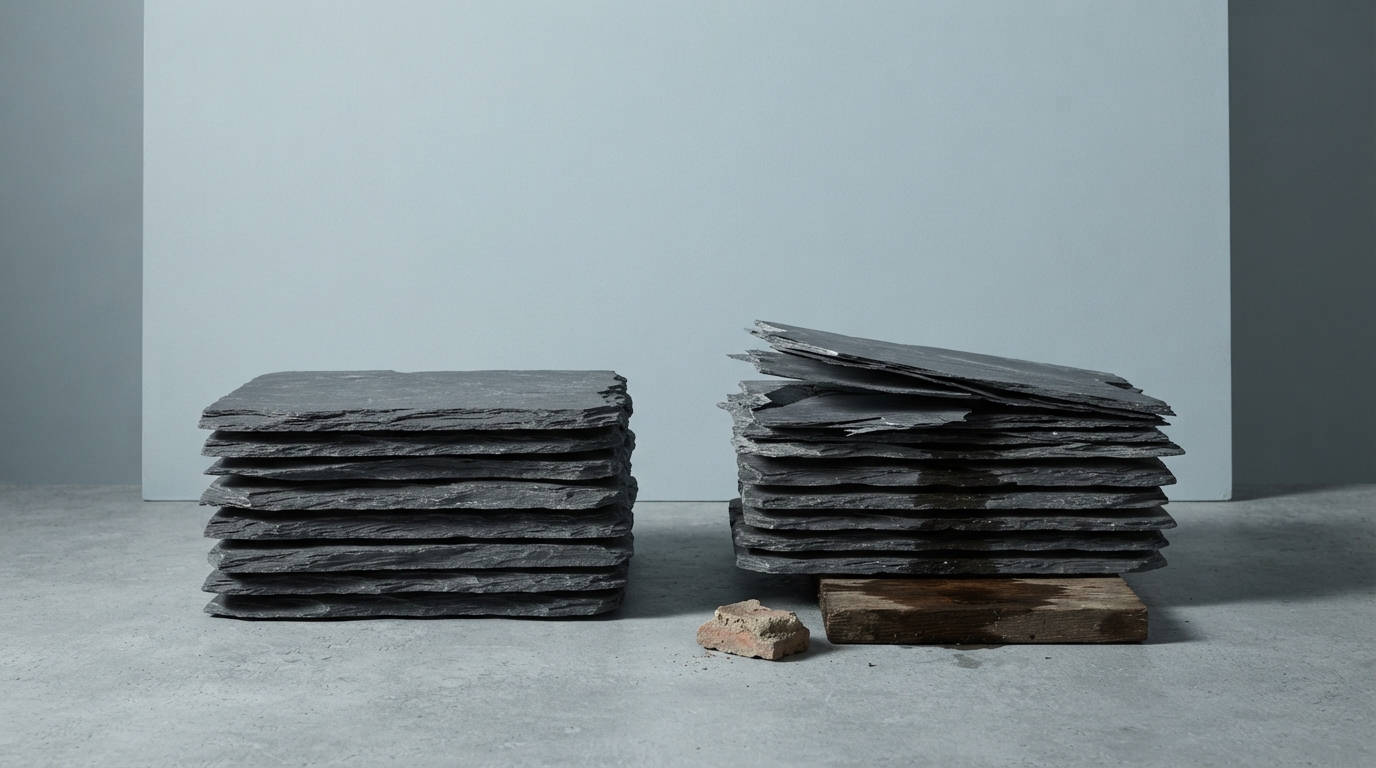
Consider a shaded Victorian tenement roof in Glasgow’s West End. Moss has already backed up the gutter and water has started running over the stonework. A pressure washer may clear the visible growth quickly, but it can also push water behind the slate courses and turn a cleaning job into concealed roof damage.
The safer route is to remove growth with a method matched to the roof’s condition, then treat the slate so spores do not quickly re-establish. The visible result takes longer to achieve than a blast of water, but it keeps the roof’s material and weathering system intact.
Approved Cleaning Techniques: Manual Scraping Versus Low-Pressure Steam Cleaning
The right method depends on the slate’s condition and the type of growth present. Our roof cleaning service starts with a survey so the cleaning method fits the roof rather than forcing one approach onto every property.
Manual scraping suits fragile, thin or aged courses where thick moss needs lifting without water ingress. Low-pressure steam suits dense lichen, black algae and resilient slate fabric where thermal cleaning can release growth without abrasive force.
Manual Hand Scraping
Manual scraping removes heavy moss cushions with precision tools shaped to the slate edges. The aim is to lift growth cleanly, without scoring the face of the slate or levering against its corners.
Choose this method when:
- Slates are brittle, delaminating or affected by nail sickness.
- Thick moss sits along slate edges, valleys or lower roof courses.
- The roof has fragile graduated courses that cannot take mechanical force.
- Original lead hips, valleys or detailed junctions need close control.
The technician works from suitable access rather than walking directly across the roof. Cherry pickers, tower scaffolds and high-reach equipment keep weight off fragile slates.
Low-Pressure Steam Cleaning
Low-pressure steam cleaning uses steam at 150°C to dissolve stubborn lichen bonds and clear black algae without abrasive water force. It is suited to robust slate that carries dense biological growth.
Choose this method when:
- Black lichen or biofilm has bonded firmly to the slate surface.
- The slate is sound enough for a controlled thermal clean.
- A careful survey has ruled out fragile edges and failing fixings.
- The roof needs growth removed from hard-to-reach details without harsh washing.
The low-pressure part matters as much as the temperature. Steam cleans through heat rather than a forceful water jet, so it avoids the pressure-washing route that drives water beneath overlaps.
Access Comes First
A Category B listed terrace in the Park District may have a steep roofline with multi-storey eaves. In that setting, a van-mounted cherry picker can reach the work area without technicians crossing the Scots slate, reducing the chance of cracked tiles or disturbed fixings.
Before work starts, surrounding greenery is pre-wetted and downpipe entry points are sealed. Once the slate is clear, gutters, hoppers and downpipes are vacuumed and flushed before the biocide stage.
For roof cleaning, the decision rule is simple: use hand scraping for fragile slate and heavy clumps, and use controlled steam where the slate condition and bonded growth support it.
Biocide Softwashing: The Vital Second Step for Long-Lasting Protection
Visible moss is only part of the problem. Biocide treatment after scraping or steam cleaning is needed because microscopic spores and rhizoids can remain inside slate pores after the roof looks clear.
The Historic Scotland guide on repairing Scottish slate roofs supports the careful retention of traditional slate. Keeping growth from returning quickly is part of that care.
A government-approved biodegradable biocide wash sanitises the slate surface and continues working through subsequent rainfall. It reaches the organic material left in small fissures, where water-only cleaning leaves the roots that restart growth.
The sequence matters:
- Remove heavy moss and bonded surface growth with manual scraping or low-pressure steam.
- Clear gutters, hoppers and downpipes so loosened debris cannot block drainage.
- Pre-soak nearby lawns and flowerbeds, then isolate downpipes before treatment.
- Apply biocide across every roof elevation, including valleys, dormers and sheltered areas.
- Carry out a final washdown of walls, windows and surrounding ground surfaces.
Water-only cleaning can leave a roof looking clean while growth returns within 6 to 12 months. Biocide softwashing tackles the organic root system instead, with treatment longevity of 3 to 5 years.
Our completed roof treatments include a written 3-Year Moss-Free Guarantee. That guarantee follows the full clean-and-treat process, not a surface rinse alone.
Glasgow’s wet conditions make this second stage worth insisting on. Scraping deals with what you can see. Biocide deals with what remains behind.
Roofing Characteristics Across Glasgow’s Prominent Conservation Neighborhoods
Glasgow’s conservation neighbourhoods put different pressures on slate roofs. Roof cleaning in Glasgow needs to account for roof pitch, shade, rain exposure, access and original detailing before work begins.
1. Glasgow West End & Kelvinside
This area has Victorian tenements and blonde sandstone terraces with steep Scots slate pitches under heavy tree canopy shade. Elevated access is often needed to reach the roof without stepping on aged slates.
Pros
- Steep pitches allow rainwater to shed when gutters remain clear.
- Original Scots slate remains a defining roof material.
Cons
- Tree shade encourages persistent moss and lichen growth.
- High rooflines often need MEWP cherry picker access.
Why Choose Glasgow West End & Kelvinside Over Pollokshields?
Choose the West End or Kelvinside where the main issue is shaded tenement roofscape and high-level access. Pollokshields more often involves detached villas with ornate roof details.
2. Pollokshields (East and West)
Pollokshields has Victorian and Edwardian villas with lead hips, valleys, turrets and delicate Scots slate layouts. Cleaning needs close control around those detailed junctions.
Pros
- Detached and semi-detached layouts can give access equipment more working space.
- Original lead and slate details reward careful retention.
Cons
- Turrets and valleys create more places for moss and debris to collect.
- Lead hips require cleaning methods that avoid damage to original detailing.
Why Choose Pollokshields Over Park District?
Choose Pollokshields for ornate villa roof structures with multiple lead and slate junctions. Park District work focuses more on steep, multi-storey townhouse rooflines.
3. Park District
The Park District is known for grand neoclassical terraces, steep mansard slopes and Welsh or Ballachulish slate. Multi-storey eaves make access planning central to the work.
Pros
- Specialist elevated access can reach high roof areas without foot traffic.
- Non-abrasive cleaning protects historic slate on steep slopes.
Cons
- Mansard pitches make direct roof access unsafe for fragile slate.
- High eaves require specialist access equipment.
Why Choose Park District Over Shawlands & Strathbungo?
Choose the Park District where steep mansards and high eaves define the job. Shawlands and Strathbungo more often need care around graduated courses and sandstone parapets.
4. Shawlands & Strathbungo
These areas combine Victorian streetscapes, traditional tenement blocks and Alexander Greek Thomson terraces. Graduated slate courses sit alongside red sandstone details that need protection during washdown.
Pros
- Graduated courses retain the character of traditional roof construction.
- Careful drainage control protects nearby sandstone detailing.
Cons
- Slate sizes diminish across the roof, requiring close manual work.
- Sensitive parapets need protection from debris and runoff.
Why Choose Shawlands & Strathbungo Over Dennistoun?
Choose Shawlands or Strathbungo where graduated slate courses and sandstone parapets set the cleaning requirements. Dennistoun faces greater exposure to westerly rain and atmospheric moisture.
5. Dennistoun
Dennistoun’s broad residential streets include slate-roofed tenements exposed to prevailing westerly winds. Moisture accumulation makes ongoing biocide care a sensible part of roof maintenance.
Pros
- Proactive biocide treatment helps manage recurrent organic growth.
- Gutter clearance supports rainwater flow on exposed rooflines.
Cons
- Westerly rain keeps roof surfaces damp for longer.
- Atmospheric moisture supports moss, algae and lichen growth.
Why Choose Dennistoun Over Glasgow West End & Kelvinside?
Choose Dennistoun where wind-driven rain and moisture are the central concern. The West End and Kelvinside bring heavier tree shade and more frequent high-access constraints.
Pricing and Maintenance Costs for Slate Roof Cleaning in Glasgow
Outside Clean roof cleaning starts at £700 for a standard residential property. Large heritage estates and complex multi-pitch slate roofs can reach £6,000, as set out on our roof cleaning services page.
The price reflects the work needed to protect the roof, rather than a quick wash. A survey establishes the access plan, condition of the slates and level of biological growth before the work is priced.
| Starting price | Upper range | Typical time |
|---|---|---|
| £700 | £6,000 | 1 to 2 days |
The main cost factors are:
- Total roof area.
- Roof steepness and number of pitches.
- Thickness and spread of moss, lichen and algae.
- Slate condition, including cracked tiles, delamination and nail sickness.
- Cherry picker or other specialist access requirements.
- Gutter clearance, downpipe protection and full ground washdown.
A standard domestic clean usually takes 1 to 2 days, including drainage clearance and post-job cleanup. Complex heritage roofs need more planning because technicians must protect original slates, leadwork and access routes.
Cleaning also helps avoid a larger roof decision. Where more than 20% to 25% of slates are cracked, broken or missing, complete reslating is recommended over individual patching. A condition survey helps separate a cleanable roof from one that has reached that point.
Ask for a survey that sets out the proposed cleaning method and access route. That gives you a clear basis for the price and confirms the roof will be treated as historic slate, not as a surface for pressure washing.
Frequently Asked Questions About Slate Roof Cleaning in Glasgow
Do I Need Planning Permission to Clean a Slate Roof in a Conservation Area?
Routine, non-abrasive maintenance should protect the original roof fabric and avoid altering the property’s appearance. Check whether the building is listed and whether an Article 4 Direction applies before arranging work; Glasgow City Council’s conservation designations are the starting point.
How Do Technicians Avoid Breaking Old Slates?
Technicians use MEWPs, cherry pickers, tower scaffolds or high-reach equipment so they do not walk directly on fragile slates. Manual scraping is used for brittle or delaminating tiles, while controlled low-pressure steam is chosen only where the slate condition supports it.
What Happens to Moss in the Gutters and Downpipes?
Downpipe entry points are sealed before cleaning so moss slurry does not enter subsurface drainage. Gutters, hoppers and downpipes are then vacuumed and flushed, followed by a ground-level inspection for remaining debris.
Why Is Biocide Needed After Moss Removal?
Biocide treatment kills microscopic spores and rhizoids left in slate pores after visible moss has been removed. In Glasgow’s damp climate, that follow-up treatment prevents growth returning as quickly as it can after water-only cleaning.
Why Book Outside Clean for Heritage Roof Work?
Our Glasgow roof cleaning service carries £5 million in public liability cover and has a 5.0 rating from 120+ verified Google reviews. Completed roof treatments also include a written 3-Year Moss-Free Guarantee.
Protecting Your Heritage Property with Glasgow’s Slate Cleaning Experts
Historic Scots slate deserves a cleaning method that keeps its layers, fixings and overlaps intact. Choose manual scraping for fragile slate, controlled steam for sound slate with bonded growth, and biocide treatment to deal with the spores left behind.
Book an aerial roof survey today to assess the slate condition, access route and safest cleaning method for your Glasgow property.